
September 1, 2025
A 10K might sound intimidating if you’ve never run before. The truth is, anyone can get there safely with the right approach. The key isn’t to run harder every day, but to train smarter, recover properly, and fuel your body in a way that supports endurance.
This guide will walk you through the smarter path from couch to 10K, based on a few simple but powerful principles: Zone 2 training, a balanced plan, and an anti-inflammatory diet.
Build your aerobic engine
The foundation of endurance running is aerobic capacity — how efficiently your body uses oxygen to create energy. And the best way to build it is through what’s called Zone 2 training.
Zone 2 is your conversational pace. If you can talk comfortably without gasping, you’re probably in it. For heart rate guidance, a rough formula is:
Zone 2 max heart rate = 220 – (2 × your age)
So, if you’re 40, your Zone 2 ceiling is about ~150 beats per minute. Walking, jogging, or a mix — it doesn’t matter. What matters is keeping your heart rate in that golden range.
Why is this important? Because this is the zone where your mitochondria — the “energy factories” in your cells – multiply. More mitochondria means better oxygen efficiency, improved fat burning, and the endurance to go longer without feeling drained.
As ironic as it may sound, practice running slow to run faster over time! I learnt this almost a year after I got into running when I was hitting a wall with my speed.
Tools and tracking
You don’t need a lot of fancy gear to get started, but if you’re serious about training in Zone 2, a chest-strap heart rate monitor is worth the investment. Smartwatches can give you very rough trends, but they often miss the precision needed for training. I personally use the Powrlabs monitor.
If you’d rather skip gadgets, use the talk test: if you can carry on a comfortable conversation while moving, you’re in Zone 2.
Train smart
One of the most common beginner mistakes is running every day. Don’t do it. Your body needs recovery time to adapt and get stronger.
A solid beginner plan is four runs per week, spread out with rest days in between. On the non-running days, focus on strength and mobility. Yoga or Surya Namaskars (sun salutations) are excellent – start with 12 rounds, then build gradually to 24, 36, even 48 if you can. These movements not only strengthen your muscles but also keep your heart rate in Zone 2, reinforcing aerobic capacity.
Over time, you can add strength training on those days to strengthen your core and lower body. A weak core puts pressure on your knees. Simplest way to keep a solid core is doing repetitions of the Cobra pose. 50 repetitions with breaks in between, would be sufficient.
Consistency and balance matter far more than grinding it out daily. There are several training plans out on the web, but the one I really liked was from http://www.runnersblueprint.com. Sharing it here for easier access –
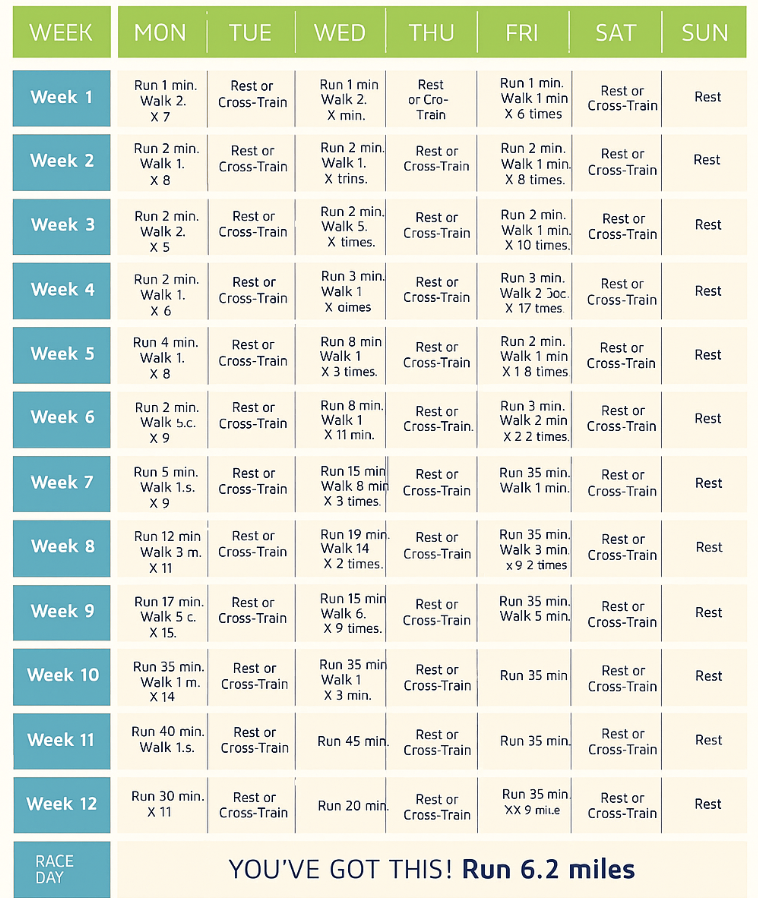
Remember to keep 80% of your runs in Zone 2 mode. From Week 6 onwards, you can add some short sprints on your Friday runs – brisk 200m sprints every 2 minutes, while keeping the rest of your runs in Zone 2.
The diet factor: Fueling for recovery and endurance
Here’s the piece most training plans skip: what you eat matters as much as how you train.
Every run creates micro-tears in your muscles. That’s normal — it’s how your body adapts. But if you fuel with pro-inflammatory foods (All purpose flour, Sugar, Dairy etc.), recovery slows down. Layer another run on top of poor recovery, and that’s when injuries happen.
You must’ve heard “Running is injury-prone.” It doesn’t have to be. The real issue is training hard on top of a body that hasn’t fully recovered.
Instead, emphasize anti-inflammatory foods. Detailed diet plans can be found here in my other article.
With this approach, running becomes not only sustainable but enjoyable. I’ve personally logged over 2,000 miles in four years with zero injuries – thanks to consistency, Zone 2 training, and an anti-inflammatory diet.
Before and after your runs
What you eat before and after runs matters too – especially as your training ramps up.
- Runs under 45 minutes: You can go out on an empty stomach, just sip some water. If you prefer a small snack, a banana works well – just wait 20–30 minutes to let it digest.
- Runs longer than 45 minutes: A light snack with carbs (like oatmeal with fruit or a slice of whole-grain toast with nut butter) helps keep your energy steady. Complex carbs release constant energy throughout and are key for good long runs.
- After runs: Aim to eat within 30–60 minutes. A mix of protein and complex carbs helps repair muscle and replenish energy. Example: Smoothie with berries and unprocessed protein powders/chia seeds/hemp seeds.
Think of food as part of your training – it’s what turns effort into progress.
From 5K to 10K and beyond
Once you’ve built a base, the leap from 5K to 10K isn’t about running faster – it’s about running longer, gradually. Add about 10% to your longest run each week, keeping the effort in Zone 2. The beauty of Zone 2 is that it makes longer distances feel manageable instead of punishing.
The first time you cross that 10K finish line, it won’t feel like luck. It’ll feel like the natural outcome of smart, consistent training.
The smarter path forward
Running success comes down to three pillars: train in Zone 2, give your body recovery days, and fuel with foods that reduce inflammation. Do this consistently, and the 10K – and even marathons down the line – will come naturally.
So lace up your shoes, slow down, eat smart, and trust the process. From couch to 10K, the magic happens when you give your body the space to adapt and thrive.
Disclaimer: This guide is intended for educational purposes only and is not a substitute for professional medical advice. Always consult your doctor or a qualified health professional before beginning any new exercise or diet program.
 Journey to well being